
Your existing tractor may be suitable for GPS auto-steering, so replacing the machine is not necessarily the first step. If you want to buy a GPS tractor steering system in the UK, the right fit depends on your tractor’s make, model and steering setup, as well as the accuracy your work requires.
Assess these details before choosing a system. This guide explains the main steering options, how satellite corrections affect accuracy, and which guidance levels may suit tasks such as drilling, spraying and general fieldwork.
You’ll also learn what to consider when matching equipment to your tractor, and how steering and correction choices shape the setup. This gives you a practical basis for narrowing down the options and choosing a system for your work.
Key Takeaways
- Start by matching the guidance system to your tractor’s make, model and steering arrangement before narrowing down your options.
- Choose an accuracy level around the work you need to repeat, from general field operations to precise inter-row tasks.
- Factor the correction method into your decision, as it affects both guidance performance and ongoing costs.
- Explore the FJD AT2 Lite GPS Tractor Auto-Steering System as one option when considering GPS steering equipment for your tractor.
Compatibility filtering by machine make and model
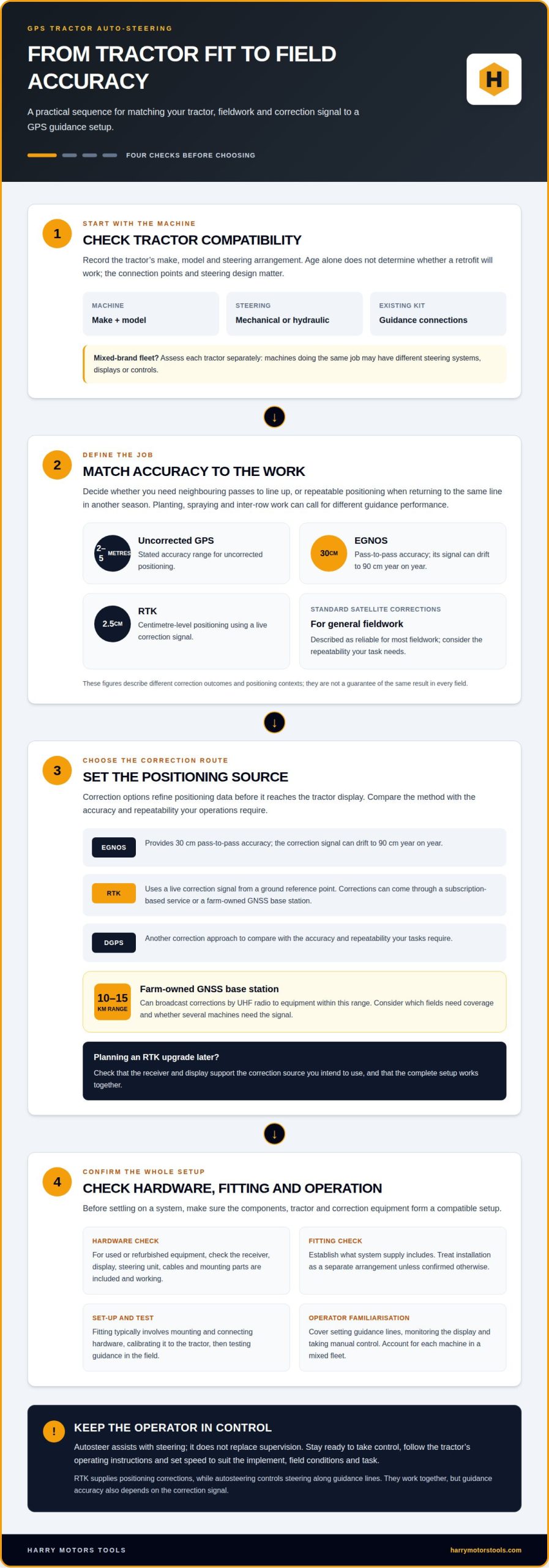
Start with the tractor’s make, model and steering arrangement. Note the model designation and whether the steering is mechanical, hydraulic or already connected to guidance equipment. Then compare those details with the system’s hardware requirements. Age alone does not determine whether a retrofit will work: the connection points and steering design are central to compatibility.
For a mixed-brand fleet, assess each tractor separately. Two tractors used for the same spraying work may have different steering systems, displays or controls. Make a fleet list of each model and its steering setup. This helps show whether one guidance system suits every tractor or whether individual machines need different components.
Treat autosteer as steering assistance, not a replacement for supervision. Stay ready to take control and follow the tractor’s operating instructions during fieldwork. GPS guidance does not remove your responsibility to monitor the machine.
Equipment sellers don’t necessarily provide fitting as part of a sale. Treat system supply and installation as separate arrangements, and establish what the seller’s offer covers before making a decision.
For used or refurbished equipment, check that the receiver, display, steering unit, cables and mounting parts are included and in working condition. Compare them with the intended tractor’s make, model and steering arrangement. Also check that the display and correction equipment work together as a complete setup.
Fitting typically involves mounting and connecting the hardware, calibrating it to the tractor, and testing guidance in the field. Operator familiarisation should cover setting guidance lines, monitoring the display and taking manual control. For a mixed fleet, calibration and instruction should account for each machine’s controls and steering behaviour.
Guidance accuracy and suitable field applications
Match the correction level to the work you repeat and the accuracy it requires. Planting, spraying and variable-rate operations place different demands on GPS guidance.
Satellite Correction Levels
Standard satellite corrections provide pass-to-pass accuracy described as reliable for most fieldwork. EGNOS correction provides 30 cm pass-to-pass accuracy, while uncorrected GPS can be accurate to 2-5 m. Consider whether your operation needs neighbouring passes to align, or whether it needs repeatable positioning across seasons. That distinction helps you select a receiver and correction signal suited to your work.
RTK and Autosteering Features
RTK provides 2.5 cm accuracy using a live correction signal from a ground reference point. That centimetre-level precision can suit planting, controlled traffic farming and inter-row work, where following the same line matters. Autosteering controls the tractor’s steering along guidance lines; RTK supplies positioning corrections. They work together, but accuracy depends on the correction signal as well as the steering hardware.
Accuracy at Operating Speeds
Accuracy figures describe positioning performance, not recommended operating speed. Set your speed to suit the implement, field conditions and task, whether planting or spraying. The receiver guides the machine along its chosen line, but you remain responsible for the operation. Compare guidance performance with the work you do at your usual pace. A stated accuracy does not guarantee the same result in every field.
RTK Base Station Options
A farm-owned GNSS base station can broadcast corrections by UHF radio to equipment within a 10-15 km range. RTK can then support centimetre-level, repeatable positioning year after year. Consider the fields and machines that need the signal, plus the base station’s coverage across your operation. For a system choice that suits your accuracy needs, explore GPS tractor auto-steering systems alongside the correction options available.
RTK, DGPS, and satellite correction options
Correction options refine positioning data before it reaches the tractor display. Standard satellite corrections can suit general fieldwork, while RTK is useful when you need consistent positioning across repeated operations. DGPS is another correction approach. Compare each method with the accuracy and repeatability your tasks require rather than treating them as interchangeable.
EGNOS provides pass-to-pass accuracy of 30 cm, but its correction signal can drift to 90 cm year on year. That distinction matters for work where you return to the same line in another season. For example, a pass that is adequate for a one-off operation may not give the same repeatability for later planting or inter-row work.
RTK uses a live correction signal from a ground reference point. You can receive corrections through a subscription-based service or a farm-owned GNSS base station. A farm-owned base station broadcasts corrections by UHF radio to equipment within a 10-15 km range. The suitable route depends on which fields need coverage and whether several machines need the signal.
Check how the receiver, display and correction source work together before choosing a setup. If you plan to start with standard corrections and move to RTK later, choose hardware that supports an upgrade. This lets you adapt the correction option as your fieldwork changes, without having to replace your approach as your operation develops.
During fieldwork, use the display to monitor guidance and overlap. If passes do not line up as intended, consider whether the correction signal suits the task and whether the receiver is using the right source. For straight, repeatable work, factor correction choice into planning alongside the tractor and implement.
Tractor GPS system price ranges by steering type
Steering type determines how guidance is shown and whether the tractor steers itself. Visual guidance shows a line on the display for you to follow manually. Assisted steering helps control the tractor, while automated autosteer follows a set guidance path. Consider how much operator involvement you want in the cab.
Visual guidance may suit operations where you prefer to steer using the display as a reference. Assisted steering adds control support, while automated steering follows the selected line. RTK is a correction method, not a steering type. It can be paired with compatible guidance hardware when a task needs repeatable positioning.
Hydraulic steering is one way to control a tractor, and the required hardware depends on the machine. Consider how the tractor steers, which implements it works with and whether you need to manage multiple guidance lines. For example, a machine used for both spraying and field preparation may need a different level of automation from one dedicated to a routine task.
UK suppliers may offer a manufacturer warranty and product guidance, but the cover and support vary by supplier and system. A warranty is not the same as servicing or repairs. Direct customer support can help you understand product information and system suitability; fitting and on-site installation are separate from equipment supply.
Trimble is one name in agricultural guidance, but the brand alone does not determine which steering arrangement fits your tractor. Focus on the machine’s steering system, your preferred level of control and the guidance functions each operation needs. This keeps your choice grounded in how you farm, rather than a headline feature.
Harry Motors Tools: FJD AT2 Lite GPS Tractor Auto-Steering System
The FJD AT2 Lite GPS Tractor Auto-Steering System is an option to consider if you want to add GPS auto-steering to your tractor. Its suitability depends on your machine and the guidance accuracy your fieldwork requires, so match those needs before choosing a system.
Harry Motors Tools sells this system alongside other GPS tractor auto-steering systems. If you’re comparing options, the team can help you understand the product information and how it relates to your requirements. The system comes with a manufacturer warranty.
For a useful enquiry, describe your tractor and the work you want GPS steering to support, such as planting or spraying. Contact Harry Motors Tools to discuss the FJD AT2 Lite and your requirements.
Choose a system around your next field operation
Before deciding, consider how guidance will fit into your working day. A tractor used for several tasks may need a different setup from one dedicated to a single operation. Think about who will use the display, which jobs matter most and whether your guidance needs may change over time. These practical details can help narrow down the options without making the highest precision the automatic choice.
If you’re ready to buy a GPS tractor steering system in the UK, take your tractor details and intended work into the discussion. Harry Motors Tools’ team can offer product guidance on its GPS tractor auto-steering systems, including the FJD AT2 Lite. The right conversation starts with your machine and the jobs you need to carry out, not a one-size-fits-all assumption.
Contact Harry Motors Tools about tractor GPS to discuss the options and take your next step with confidence.
Frequently Asked Questions
Can auto steer be fitted to my existing tractor?
GPS auto-steering can often be retrofitted, but compatibility depends on your tractor’s steering arrangement and the system hardware. Start with the make, model and existing guidance equipment, then compare the components required for that machine. Brand-agnostic systems may suit tractors five to twenty-five years old, but age alone does not establish compatibility. Assess each tractor in a mixed-brand fleet separately.
Do I need an RTK subscription?
No, an RTK subscription is not essential for every GPS guidance setup. Standard satellite corrections can suit general fieldwork, while RTK requires a live correction signal for centimetre-level positioning. A farm-owned GNSS base station is another way to supply RTK corrections. Choose based on whether tasks such as repeat planting need consistent positioning or pass-to-pass guidance is sufficient.
What are the best GPS steer systems for older tractors?
The best choice is the system that matches your older tractor’s steering arrangement, rather than one selected by age alone. Brand-agnostic systems may work with tractors five to twenty-five years old, but models within that range can still need different hardware. Compare the receiver, display and steering components against the machine’s details. The FJD AT2 Lite is one GPS auto-steering option to consider.
Why is Everyone Talking about GPS for Farm Tractors Anyway?
GPS guidance helps operators follow planned lines across a field, which can reduce missed ground and overlapping passes. Manual steering typically creates 10% overlap, and GPS tractor systems can reduce field overlap by more than 90%. Less overlap can help make field operations more consistent. The value depends on your tasks, field layout and how accurately you need to repeat a pass.
How much does a GPS tractor steering system cost in the UK?
The total depends on the steering hardware, receiver and display, correction method, and the tractor’s compatibility requirements. Visual guidance differs from assisted or automated steering, and adding RTK corrections changes the system requirements. Compare complete configurations for the same machine and work rather than judging by one component. This gives you a clearer picture of what each option includes.
What is the difference between RTK, RTK-ready and standard GPS tractor steering accuracy?
Standard GPS without differential correction provides 2-5 m accuracy; EGNOS correction provides 30 cm pass-to-pass accuracy. RTK provides 2.5 cm accuracy using a live correction signal from a ground reference point. “RTK-ready” means hardware can support an RTK upgrade, but it doesn’t itself provide RTK accuracy. The correction signal must be available and used for the operation.